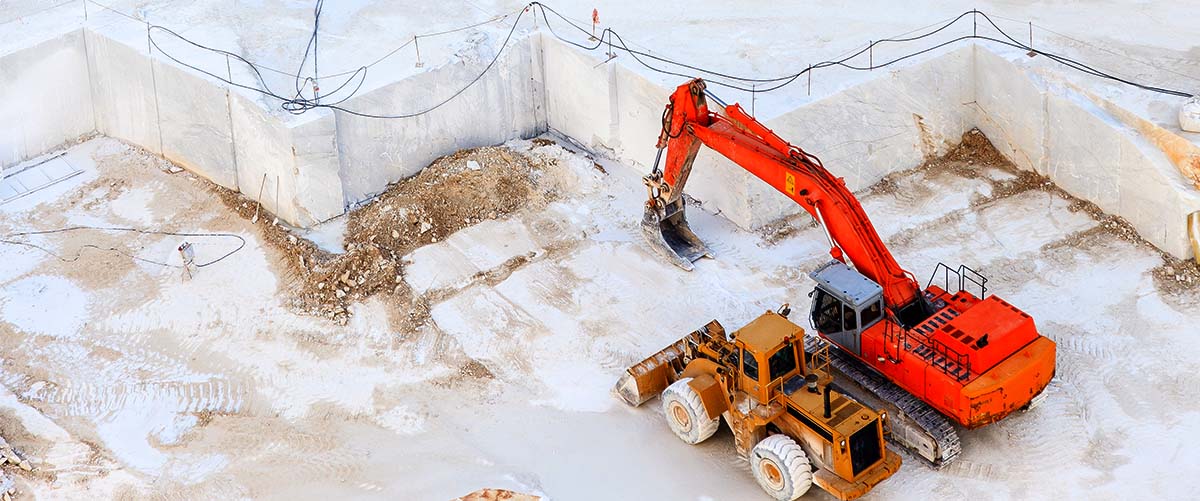
Transport emissions: the hidden carbon cost of material distance
The economic and environmental benefits of locally sourced materials begin with a straightforward physical reality: moving heavy construction materials over long distances consumes substantial energy and generates proportionate greenhouse gas emissions. Transport emissions are quantified in module A4 of the EN 15978 lifecycle framework, and while they typically represent 2-5% of total embodied carbon, this percentage conceals significant absolute values for dense materials transported over long distances.
Road freight by heavy goods vehicle (HGV) emits 0.06-0.15 kgCO2/t per km depending on vehicle class, load factor and road type (Berge 2009). For a material as commonplace as ready-mix concrete (density: 2,300-2,400 kg/m3), a haul distance of 500 km adds 72-180 kgCO2/m3 to the material's carbon footprint — equivalent to 20-50% of the concrete production emissions themselves (A1-A3: approximately 250-400 kgCO2/m3). Natural stone, another dense material (2,200-2,800 kg/m3), imported from China or India to a European building site — a maritime and road distance of 10,000-15,000 km — carries transport emissions of 25-50 kgCO2/tonne, potentially exceeding the quarrying and processing emissions of the stone itself.
Huberman and Pearlmutter (2008) conducted a detailed study of building materials in the Negev desert region of Israel, comparing local versus imported sourcing for a standard residential building. They found that sourcing all principal materials (concrete aggregate, masonry blocks, plaster, insulation) locally — within a 100 km radius — reduced total A4 transport emissions by 45-65% compared to the national average supply chain distance of 250-400 km. The savings were most pronounced for aggregate and sand (70% of concrete volume), where local quarrying eliminated the longest transport legs. For the building as a whole, local sourcing reduced total lifecycle embodied carbon (A1-A5) by 8-15%, a margin that compounds meaningfully at urban development scale.
The local economic multiplier: keeping construction expenditure in the region
The economic benefits of locally sourced materials extend well beyond logistics cost savings to encompass macroeconomic multiplier effects. The New Economics Foundation (NEF) developed the LM3 (Local Multiplier 3) methodology in 2002 to measure how money circulates within a local economy (NEF 2002). When a construction project purchases materials from a local quarry, that quarry pays local wages, buys local services and pays local taxes — each round of spending generating further economic activity. The LM3 for locally sourced construction materials typically ranges from 1.5 to 2.0, meaning that every euro spent on local materials generates 1.50-2.00 euros of total economic activity in the region.
By comparison, materials sourced from distant or international suppliers exhibit LM3 values of 1.1-1.3, as the majority of the purchase price exits the local economy after the initial transaction. Morel et al. (2001) documented this effect in a comparative study of an earth construction project in southern France versus a conventional concrete and masonry alternative. The earth building, using 95% of structural materials from within 10 km of the site, retained 68% of material expenditure within the local commune, compared to 22% for the conventional building using industrially produced materials sourced from 100-500 km distance. The labour component reinforced this advantage: earth construction required 40-60% more on-site labour hours (predominantly local workers) and 60-80% fewer factory-produced components (predominantly non-local production).
These multiplier effects have particular significance for rural and economically disadvantaged regions where construction represents a major share of local economic activity. In the EU, the construction sector employs 12.7 million workers (6.1% of total employment) and generates 1,500 billion euros in annual output (Eurostat 2023). Redirecting even 10-20% of material procurement toward local and regional sources would inject 15-45 billion euros of additional economic activity into regional economies annually — a stimulus with tangible effects on employment, tax revenue and community resilience.
Logistics cost reduction and supply chain resilience
From a purely commercial perspective, locally sourced materials reduce procurement and logistics costs by 15-35% compared to nationally or internationally sourced equivalents (Venkatarama Reddy and Jagadish 2003). The cost savings derive from multiple factors: elimination or reduction of long-distance freight charges (which can represent 10-25% of delivered material cost for dense, low-value products such as aggregate, sand and earth), reduced inventory requirements (proximity enables just-in-time delivery with lead times of 1-3 days versus 2-6 weeks for imported materials), and lower insurance and damage rates during transport.
The supply chain resilience argument gained unprecedented salience during the COVID-19 pandemic and its aftermath (2020-2023), when global construction material supply chains experienced disruptions of 3-6 months for imported products. Container shipping costs from Asia to Europe rose by 5-10 times above pre-pandemic levels (from 1,500 EUR to 8,000-15,000 EUR per 40-foot container), and shortages of imported timber, steel and insulation materials caused project delays averaging 4-8 months across EU member states. Projects relying on local material supply chains experienced significantly fewer and shorter disruptions, with delay averages of 1-3 months — primarily attributable to labour shortages rather than material shortages.
Climate adaptation provides a further rationale. Vernacular construction materials — local stone, earth, regional timber species, natural fibres — are by definition adapted to the local climate through centuries of empirical optimization. Morel et al. (2001) observed that earthen buildings in the Rhone-Alpes region of France, constructed from local clay soils, provided superior hygrothermal regulation (indoor relative humidity: 45-65% year-round without mechanical humidification or dehumidification) compared to concrete masonry buildings requiring active humidity control. This climate adaptation reduces operational energy demand by 10-25% for heating and cooling — a benefit that compounds over the building's 50-100 year service life and that is inherently absent from materials designed for universal, climate-independent application.
Certification frameworks: LEED, BREEAM and RE2020 recognition
Major green building certification systems provide explicit credit for the use of locally sourced materials, creating measurable market incentives. LEED v4.1 (MR credit: Sourcing of Raw Materials) awards up to 2 points for products sourced within 160 km (100 miles) of the project site, provided they represent at least 20% of total material cost. An additional point is available for products extracted and manufactured within 800 km. These credits contribute to the 110-point total, and in competitive certification scenarios (e.g., targeting LEED Platinum at 80+ points), regional material credits can be decisive.
BREEAM (Mat 03: Responsible Sourcing of Construction Products) assesses material sourcing through a tiered framework that awards higher scores for materials with verified supply chain documentation, environmental management systems at extraction sites and short transport distances. BREEAM does not impose a fixed distance threshold but evaluates transport impact as part of the overall Mat 03 score (up to 6 credits available). The VERDE certification system (Green Building Council Spain) includes a specific credit for regional materials, requiring at least 30% of material cost sourced within 300 km.
France's RE2020 regulation (effective January 2022) incorporates transport emissions into the mandatory lifecycle carbon calculation for all new residential buildings. Because the regulation sets absolute carbon budgets — 640 kgCO2eq/m2 for single-family houses in 2022, decreasing to 415 kgCO2eq/m2 by 2031 — any reduction in module A4 transport emissions creates direct headroom for the overall budget. French architects report that specifying local stone, regional timber and nearby concrete plants provides an A4 saving of 15-40 kgCO2eq/m2, representing 2-6% of the total allowable budget — a margin that can determine regulatory compliance in tightly optimized designs (UNEP 2022).
Practical implementation: from geological inventory to project specification
Translating the benefits of locally sourced materials into project practice requires a structured approach. The first step is a geological and resource inventory of the project region: identifying quarries, sawmills, brick factories, earth sources and recycled aggregate facilities within a 50-150 km radius, documenting their product range, production capacity, quality certifications and environmental management practices. National geological surveys — BGS (United Kingdom), BRGM (France), BGR (Germany), IGME (Spain) — provide base data, supplemented by commercial databases and site visits.
The second step is performance verification: local materials must meet the same structural, thermal, fire and acoustic standards as any alternative. This requires laboratory testing: compressive strength (EN 772 for masonry, EN 12390 for concrete), thermal conductivity (EN 12667), fire reaction (EN 13501-1) and durability (freeze-thaw: EN 12371 for natural stone). For earth-based materials, the relevant standards include DIN 18945-18948 (Germany), NZS 4298 (New Zealand), and the French guides de bonnes pratiques for rammed earth and adobe. Testing costs of 2,000-8,000 EUR per material are typically recovered through material cost savings within the first 500-1,000 m3 of procurement.
The third step is advance procurement planning. Local quarries and small-scale producers require 6-12 months of advance notice to adjust production schedules and stockpile materials for large projects. This timeline contrasts with the 2-4 week lead times available from large industrial suppliers with national distribution networks. Early engagement with local producers — ideally during the design development phase — enables specification optimization: adjusting concrete mix designs to local aggregate grading, dimensioning stone cladding to quarry block sizes, and coordinating timber specifications with regional sawmill capabilities. Berge (2009) documented that this collaborative approach reduced material waste by 10-20% and improved dimensional accuracy compared to projects specifying materials without reference to local production constraints. The benefits of locally sourced materials are therefore not automatic but emerge from deliberate, informed procurement practices that respect both the capabilities and the limitations of regional supply chains.
References
- [1]Building houses with local materials: means to drastically reduce the environmental impact of constructionBuilding and Environment, 36(10), 1119-1126.
- [2]The Ecology of Building Materials (2nd ed.)Architectural Press / Elsevier. ISBN: 978-1-85617-537-1
- [3]A life-cycle energy analysis of building materials in the Negev desertEnergy and Buildings, 40(5), 837-848.
- [4]Embodied energy of common and alternative building materials and technologiesEnergy and Buildings, 35(2), 129-137.
- [5]The Money Trail: Measuring Your Impact on the Local Economy Using LM3New Economics Foundation. ISBN: 978-1-899407-56-5
- [6]2022 Global Status Report for Buildings and ConstructionUnited Nations Environment Programme.



Comments 0
No comments yet. Be the first!
Leave a comment