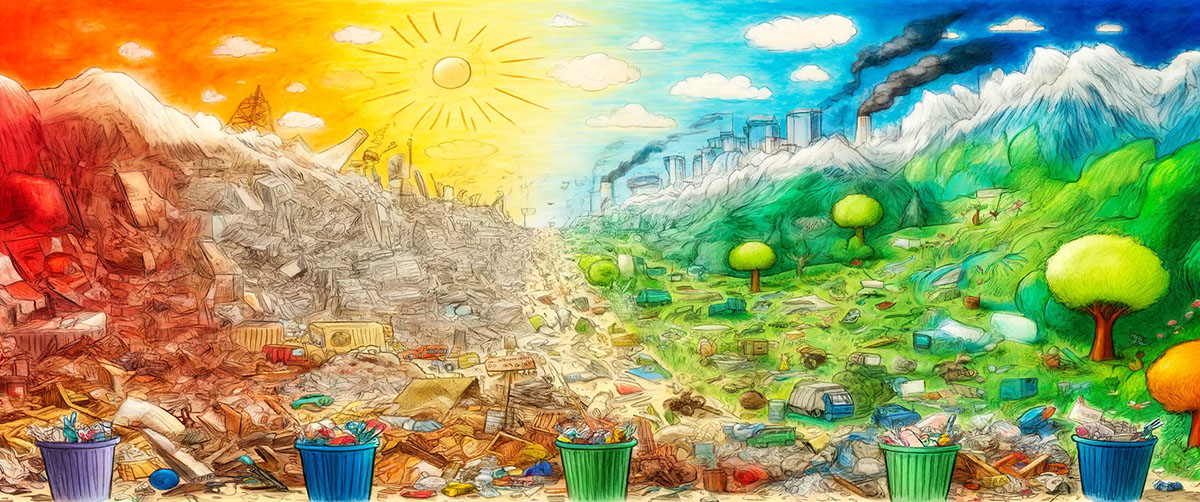
Waste classification and their differentiated contamination potential
Contamination by waste type demands a rigorous classification that links the material composition of each fraction to its specific environmental damage mechanisms. Global municipal solid waste production reached 2.01 billion tonnes in 2022 (World Bank, What a Waste 2.0, 2022 update), with a projection of 3.4 billion tonnes by 2050 if consumption and management patterns remain unchanged. The average global composition is: organic waste (44%), paper and cardboard (17%), plastics (12%), glass (5%), metals (4%), electronic and hazardous waste (2%) and other (16%). However, contamination is not proportional to volume: electronic waste represents barely 2% by weight yet concentrates 70% of the heavy metals present in landfills (UNEP, 2021). Construction and demolition waste (CDW) constitutes a separate stream that in the European Union amounts to 374 million tonnes annually, equivalent to 35.2% of total waste generated (Eurostat, 2022), with a recovery rate of 89% in countries like the Netherlands but below 40% in Eastern Europe.
The hazardousness of a waste depends on five properties defined in the Basel Convention and in European Regulation 1357/2014: toxicity (HP 6 and HP 7), flammability (HP 3), corrosivity (HP 8), mutagenicity and carcinogenicity (HP 11 and HP 7), and ecotoxicity (HP 14). Hazardous waste represents between 5% and 15% of total waste generated in industrialized countries, but its contribution to soil, water and air contamination is disproportionate. A single liter of used mineral oil can contaminate up to 1,000,000 liters of water (MITECO, 2022). A single mercury button cell battery (3 grams) contaminates 600,000 liters of water beyond potability limits. These figures demonstrate that differentiated management by waste type is not an administrative option but an ecotoxicological necessity: treating all waste as if it were homogeneous is equivalent to ignoring hazardousness differences spanning several orders of magnitude.
Organic and plastic waste: atmospheric, water and marine contamination
Organic waste deposited in landfills without biogas control generates methane (CH₄) through anaerobic decomposition, a gas with a global warming potential 28 times greater than CO₂ at 100 years and 84 times greater at 20 years (IPCC, AR6, 2021). The solid waste sector is responsible for 5% of global greenhouse gas emissions, equivalent to 1.6 billion tonnes of CO₂ equivalent annually, of which 50% comes from methane in organic waste landfills (Global Methane Assessment, UNEP, 2021). The organic fraction also generates leachate with a biochemical oxygen demand (BOD₅) of 10,000 to 60,000 mg/l, ammoniacal nitrogen concentrations of 500 to 3,000 mg/l, and dissolved heavy metals that contaminate groundwater when landfills lack waterproofing (HDPE geomembrane of at least 2 mm thickness as required by Directive 1999/31/EC). In Spain, 44 illegal landfills were still operating in 2023 according to proceedings opened by the European Commission, each one posing a risk of aquifer contamination within a radius of 1 to 5 km.
Plastic waste presents a radically different contamination profile: extreme persistence and ubiquity. Of the 400 million tonnes of plastic produced annually worldwide (OECD, Global Plastics Outlook, 2022), only 9% is recycled, 19% is incinerated and 50% is deposited in landfills, while the remaining 22% is inadequately managed or abandoned in the environment. Between 19 and 23 million tonnes of plastic enter aquatic ecosystems annually (Borrelle et al., 2020, Science). 88% of the ocean surface shows microplastic contamination (particles smaller than 5 mm), with concentrations of 10,000 to 100,000 fragments per km² in the subtropical oceanic gyres. Microplastics absorb persistent organic pollutants (PCBs, DDT, PAHs) with concentration factors of 10⁴ to 10⁶ relative to surrounding water, acting as toxicity vectors for marine fauna: microplastics have been documented in the digestive tract of 90% of seabirds studied and in 100% of sea turtle species. The degradation of a single 500 ml PET container requires between 450 and 1,000 years, generating up to 10,000 microplastic particles during its fragmentation.
Electronic, chemical and hazardous waste: concentrated toxicity
Waste electrical and electronic equipment (WEEE) constitutes the fastest-growing waste stream globally: 62 million tonnes generated in 2022, an 82% increase since 2010, with a projection of 82 million tonnes by 2030 (Global E-waste Monitor, 2024). Only 22.3% of WEEE is formally collected and treated, meaning 48 million tonnes annually are inadequately managed or unaccounted for. WEEE composition includes more than 1,000 different substances, among them valuable metals (gold: 100-350 g/tonne, silver: 300-1,000 g/tonne, copper: 10-20%, palladium: 10-50 g/tonne) and highly toxic substances (lead: 1-5%, mercury: up to 3,000 mg/unit in older LCD screens, cadmium: 0.1-0.5%, brominated flame retardants: 1-5%). Informal incineration of WEEE, practiced by 18 million people in developing countries according to the WHO, releases dioxins (PCDD/PCDF: ambient concentrations 100 to 1,000 times above WHO limits), furans and heavy metals that contaminate soils and water within a radius of 2 to 10 km.
Hazardous chemical waste from industry includes halogenated solvents (dichloromethane, trichloroethylene), concentrated acids and bases, waste containing heavy metals (hexavalent chromium, arsenic, selenium) and pharmaceutical waste. Chemical waste contamination affects more than 340,000 contaminated sites identified in the European Union (European Environment Agency, 2022), with estimated remediation costs of 6.5 billion EUR annually. Radioactive waste, although representing less than 0.1% of total volume, requires isolation periods of 10,000 to 100,000 years for high-level waste (spent nuclear fuel) — a time horizon that transcends any documented civilization. Healthcare waste, whose generation increased eightfold during the COVID-19 pandemic (from 0.5 to 4 kg per hospital bed per day), includes biocontaminated materials requiring autoclave sterilization at 134°C for 18 minutes or controlled incineration above 1,100°C to ensure pathogen destruction, according to 2022 WHO guidelines.
Construction and demolition waste: the largest flow by volume
Construction and demolition waste (CDW) constitutes the largest waste stream by volume in most industrialized countries. In the European Union, 374 million tonnes of CDW are generated annually (Eurostat, 2022), equivalent to 830 kg per inhabitant. Its typical composition is: concrete and aggregates (40-60%), bricks and ceramics (15-25%), wood (5-15%), metals (2-5%), plastics (1-3%), gypsum (1-5%) and hazardous waste (1-5%, including asbestos, lead-based paints and PCB-containing sealants). The specific contamination from CDW affects soil (compaction and pH alteration from rubble dumping, with alkaline pH values of 10 to 12 in concrete disposal areas), water (leachate with sulfates from gypsum: up to 2,400 mg/l, chromium from cement: up to 0.3 mg/l, and suspended asbestos fibers), and air (PM10 particles during demolition operations: concentrations of 500 to 5,000 µg/m³ at the site perimeter, versus the daily limit of 50 µg/m³ set by Directive 2008/50/EC).
Differentiated CDW management by waste type is fundamental to reducing its contamination impact. Asbestos, present in 80% of buildings constructed between 1960 and 1990 in Europe, requires removal by specialized companies with class III protective equipment, encapsulation in double bags of 200 µm thickness, and disposal in specific landfill cells with 2 m of earth cover. Lead-based paints (concentrations of 1,000 to 50,000 mg/kg of Pb), common in pre-1978 buildings, contaminate surrounding soil if removed by sanding without containment, generating inhalable dust with lead levels 10 to 100 times above the 1.5 µg/m³ limit set by OSHA. In contrast, the clean stone fraction (concrete, brick, ceramics free of contaminants) can be recycled as substitute aggregate for road sub-bases, fills and non-structural concrete, with substitution rates of up to 30% of natural aggregate according to standard EN 12620:2002. The Waste Framework Directive 2008/98/EC establishes a 70% recovery target for CDW, a threshold met by 18 of the 27 Member States in 2022, with the Netherlands (97%), Denmark (95%) and Germany (91%) serving as benchmarks for differentiated management by waste type.
References
- [1]What a Waste 2.0: A Global Snapshot of Solid Waste Management to 2050 — Updated DatasetWorld Bank Group. ISBN: 978-1-4648-1329-0
- [2]The Global E-waste Monitor 2024United Nations University (UNU) / UNITAR / ITU. ISBN: 978-92-808-9193-9
- [3]Predicted Growth in Plastic Waste Exceeds Efforts to Mitigate Plastic PollutionScience, 369(6510), 1515-1518.
- [4]Global Methane Assessment: Benefits and Costs of Mitigating Methane EmissionsUNEP / Climate and Clean Air Coalition.
- [5]Generation of Waste by Waste Category, Hazardousness and NACE Rev. 2 Activity — Construction WasteEuropean Commission, Eurostat.
- [6]Global Plastics Outlook: Economic Drivers, Environmental Impacts and Policy OptionsOECD Publishing, Paris. ISBN: 978-92-64-98422-1

Comments 0
No comments yet. Be the first!
Leave a comment